android arm64 android-api-36 soc-mediatek-mt6899 android-npu npu-neuron
Your old phone is an ARM64 Linux machine with an NPU that happens to be sitting in a drawer. DroidRunner makes GitHub Actions treat it as one.
A single APK runs the official GitHub Actions runner on an Android device. No root. No Termux. No PC attached.
aarch64
$ droidrunner-device capabilities
device Xiaomi 2511FPC34G · android 16 (api 36)
soc mediatek mt6899
nnapi mtk-neuron_shim, mtk-dsp_shim, mtk-mdla_shim, nnapi-reference
thermal none · battery 93% charging
√ Connected to GitHub · Listening for Jobs
why
GitHub's hosted ARM64 runners are virtual machines. They cannot tell you whether your model actually runs on a Qualcomm Hexagon, a Google Tensor TPU, or a MediaTek APU — because there is no NPU behind them, and no vendor driver stack either.
The devices that can answer that are the ones already in the drawer. DroidRunner's goal is a pool of real phones that CI can dispatch to by label, so "does this build work on ARM64" and "does this model run on that vendor's NPU" become the same kind of question: a job that runs on a push.
why a phone and not a single-board computer
The honest alternative to a phone is not a virtual machine — it is a Raspberry
Pi on the shelf, or paying for hosted ARM64 minutes. Hosted linux-arm64
runners are free for public repositories and billed for private ones, so for a
private repo the real comparison is a board you buy against a handset you already
own.
| Raspberry Pi 5 | a phone from the drawer | |
|---|---|---|
| cost | board, PSU, storage, case | already paid for |
| NPU | none | the reason this project exists |
| GPU for compute | not in practice | reached by the TFLite delegate |
| power cut | it stops; a UPS costs extra | the battery is the UPS |
| state display | add a screen | it has one |
| Linux | ordinary, with root | PRoot, no root, vendor power management |
The board wins on being a normal computer. Root, predictable Linux, GPIO, and no vendor deciding what may run in the background. If your CI is a build and a test suite and nothing touches an accelerator, buy the board — it is the simpler machine, and this project is not trying to talk you out of it.
The phone wins the moment the question involves silicon. Everything further down this page — which driver actually ran a graph, which operators a vendor refuses, what an accelerator computed rather than merely who computed it — is unanswerable on a board with no NPU, and unanswerable on a VM for the same reason.
dashboard
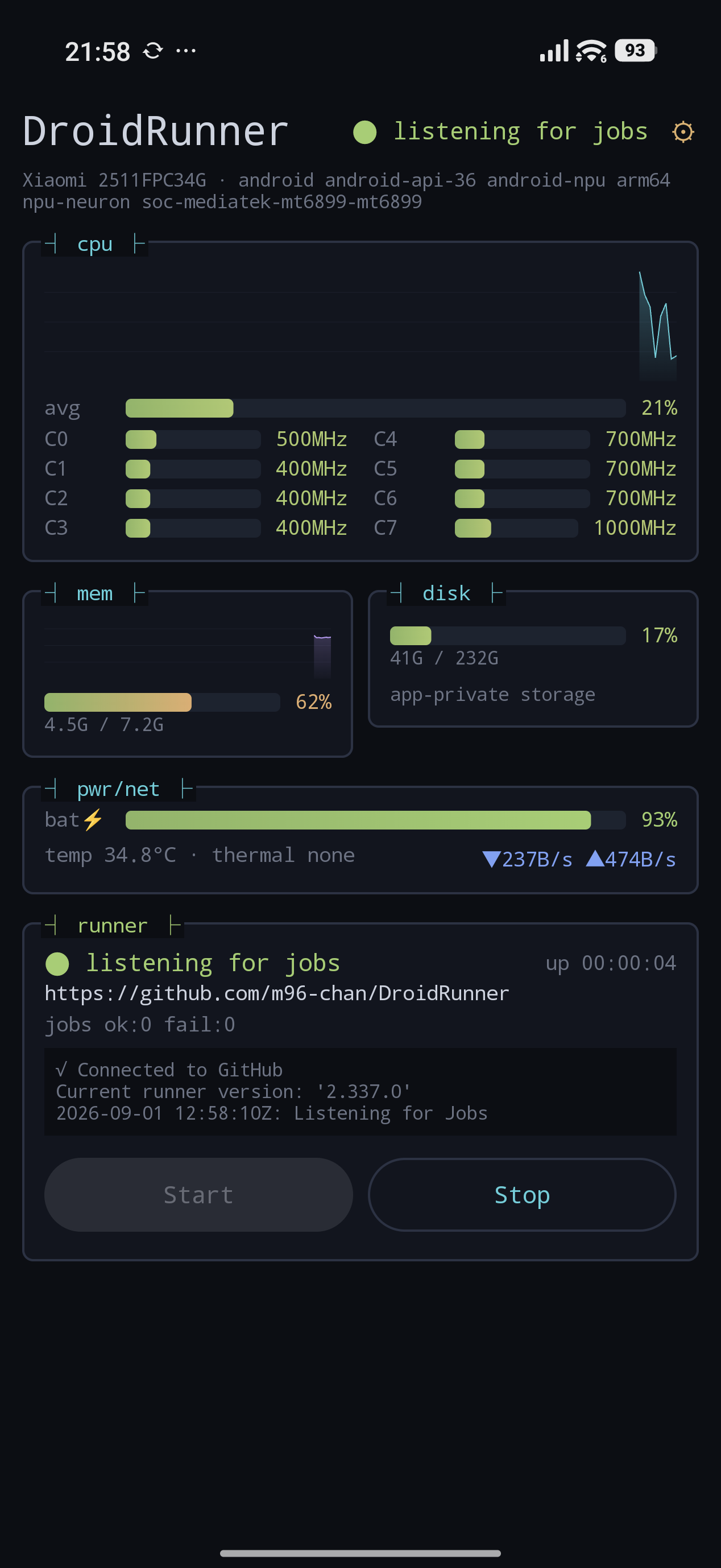
- cpu
- Load history and per-core meters with live frequency.
- mem / disk
- RAM and app-private storage, with history.
- pwr/net
- Battery level and charging state, battery temperature, Android thermal status, network throughput.
- runner
- State, registered target, uptime, job counters and a live tail of the runner log — parsed straight from the official listener's output.
- setup (⚙)
- A separate screen: sign-in, target picker, registration, job policy. Once a device is registered, the runner starts on its own at launch.
how it works
GitHub Actions
      ↓  job dispatched by label
┌─ DroidRunner APK ────────────────────────────────┐
   Android controller  → Keystore (user token)
      ↓
   PRoot + Ubuntu ARM64 rootfs
      ↓
   Official Linux ARM64 Actions Runner
      ↓  loopback + per-job capability token
   Device Agent  → NNAPI / QNN / Neuron / ENN
└──────────────────────────────────────────────────┘
Shells, Git, Node, Python, Rust, Go and Gradle run inside PRoot like on any Linux box. Anything that needs an Android API or the NPU cannot be reached from inside that namespace, so it is delegated back to the app over a loopback API that only accepts a token minted for the running job.
proot itself ships inside the APK as a native library, because Android 10
and later refuse to exec() a binary out of app data storage. The
downloaded runtime bundle is therefore data only — and its manifest is signed,
so a device will not fetch a rootfs nobody vouched for.
features
Single APK
No companion app, no Termux, no scripts to paste.
No root
A Linux ARM64 environment on top of PRoot.
Official runner
GitHub's own linux-arm64 Actions runner, unmodified.
GitHub App login
Device-flow sign-in with a target picker. No PAT to create, no client secret in the APK.
Repo or org scope
Serve one repository, or every repository in an organization.
Automatic labels
Android API level, SoC and NPU hints become runner labels.
Self-protecting
Holds jobs while the device is hot, short on space, or on battery and below your threshold. Mains-only is a setting, off by default.
Crash recovery
Restarts the listener on its own, with backoff.
Ephemeral mode
Re-registers and wipes the work directory after every job.
Signed runtime
ECDSA-signed manifest, verified against keys compiled into the APK.
Keystore credentials
The GitHub token is encrypted by Android and never enters the Linux side.
Background standby
Foreground service and wake lock keep the runner alive.
a job on your phone
jobs:
  test:
    runs-on: [self-hosted, android, arm64]
    steps:
      - uses: actions/checkout@v4
      - run: uname -a
      - run: ./ci/test-arm64.sh
Or ask the silicon a question:
runs-on: [self-hosted, android, nnapi-accelerator]
steps:
  - run: droidrunner-device capabilities   # device info, thermal, drivers
  - run: droidrunner-device bench-all      # CONV_2D on every driver
DEVICE                       AVG_US     GFLOPS
mtk-dsp_shim                      - compilation_finish
mtk-mdla_shim                     - compilation_finish
mtk-neuron_shim              4148.9       4.55
nnapi-reference              1107.7      17.04
The two drivers that refused the job wanted a quantized model, not float32. That is precisely why labels are meant to come from probes rather than from parsing an SoC name.
labels
| Label | Meaning |
|---|---|
android | A physical Android device running DroidRunner |
arm64 | ARM64 device |
android-api-N | Android API level |
soc-* | Detected SoC |
android-npu | The SoC family is known to have an NPU. A hint, not a promise |
nnapi-accelerator |
An accelerator answered the probe — the label to select on |
npu-qnn |
A model has run on this phone's Hexagon — measured, not guessed |
npu-tflite / npu-neuron / npu-enn |
LiteRT / MediaTek Neuron / Samsung ENN candidate, from the SoC name |
nnapi, nnapi-accelerator and npu-qnn come
from asking the device; the rest are candidates derived from the SoC name.
Select on a measured one when a job needs acceleration, or it may quietly get a
CPU. npu-qnn used to be a guess and is now earned: a Snapdragon
carries it only after a model has been shown to run on its Hexagon.
what a phone answers that a VM cannot
EfficientNet-Lite0, same model and same harness on three phones. Every row says which processor actually ran it, not which one was asked for.
| device | driver | int8 | float32 |
|---|---|---|---|
| Tensor G4 | google-edgetpu | 0.65 ms | 16.7 ms |
| SM8650 | qnn-htp (Hexagon) | 1.22 ms | 2.78 ms |
| SM8650 | gpu (Adreno, TFLite delegate) | 4.95 ms | — |
| MT6899 | mtk-neuron_shim | 2.12 ms | 7.29 ms |
| MT6899 | mtk-mdla_shim | 2.69 ms | fell back to the CPU |
| Tensor G4 | NNAPI's own choice | 5.65 ms | — |
| SM8650 | nnapi-reference (CPU) | 113 ms | 39.8 ms |
| MT6899 | nnapi-reference (CPU) | 257 ms | 106 ms |
Some cells are not the accelerator at all. MediaTek's MDLA refuses float32 outright and the CPU picks it up. An earlier version of this page would have printed that as a number; every result now reports who executed it, and a fallback says so.
Letting NNAPI choose costs most of the speedup — and it cannot reach a Hexagon at all, which is why that row needs the opt-in on the device.
which operators the silicon will take
A whole network cannot tell you. One refused node pushes its entire partition back to the CPU, so a fallback says a vendor's table is wrong somewhere without saying where. So: one model per operator per precision, 62 of them, run on every driver the phone exposes.
| driver | float32 | int8 |
|---|---|---|
qnn-htp (SM8650 Hexagon) | 31/31 | 31/31 |
gpu (SM8650 Adreno, TFLite delegate) | 31/31 | 31/31 |
mtk-neuron_shim (MT6899) | 28/31 | 30/31 |
mtk-mdla_shim (MT6899) | 0/31 | 30/31 |
mtk-dsp_shim (MT6899) | 10/31 | 19/31 |
google-edgetpu (Tensor G4) | 0/31 | 29/31 |
Every model is also run with no accelerator at all. One that will not run on the CPU either is a defect of ours, and it is excluded and marked as excluded rather than filed as an operator some driver refuses.
Each phone's table is kept, and the next run is compared against it. A driver that stops taking an operator after a system update turns a build red. That check needs the same phone, kept — it is not available to anyone renting machines by the hour.
status
Everything marked working has run on a real device, not just in CI. The README carries the detail. blocked means every route was tried and each one needs a library that is absent or not loadable by an app — see issue #83.
before you start
- A self-hosted runner runs arbitrary workflow code on your phone. Never let it pick up pull requests from forks of a public repository.
- An organization runner accepts jobs from every repository in the org unless you put it in a runner group with an allow-list. Repository scope is the default for a reason.
- Use a device that is dedicated to CI and wiped, not the phone you carry.
- PRoot is a compatibility layer, not a security boundary like a container or a VM.
- Docker actions, service containers, KVM and nested virtualization are not available.